How to Use AI to Instantly Format Messy OCR Text into Clean Markdown Tables
How to Use AI to Instantly Format Messy OCR Text into Clean Markdown Tables
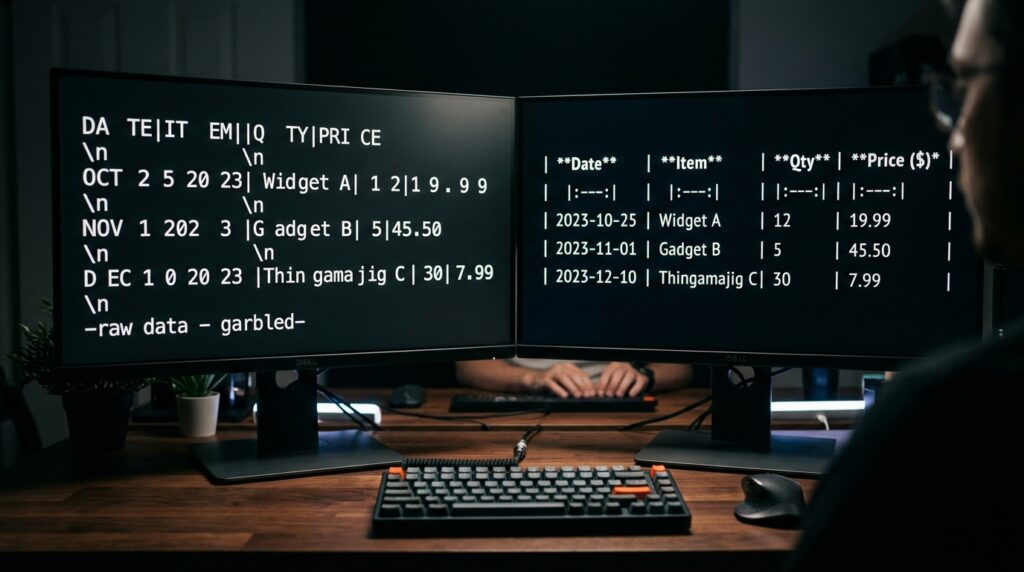
For the purpose of transforming scanned documents, pictures, and PDFs into text that can be edited, optical character recognition (OCR) has emerged as a de facto standard technique. On the other hand, despite the fact that it is beneficial, the output of OCR is often disorganised, uneven, and poorly organised. The data that has been extracted may become difficult to utilise because the tables may lose their alignment, the columns may merge in an inappropriate manner, and the spacing may become irregular. This presents a particularly difficult challenge when dealing with bills, reports, research data, or financial records, all of which need standardised formatting in significant amounts. The immediate transformation of raw OCR data into clean, organised Markdown tables is a challenge that can be solved by artificial intelligence. The process of cleaning, organising, and standardising optical character recognition (OCR) material may be automated by users via the use of language models that provide robust formatting capabilities. In addition to enhancing the readability of data across documentation, reporting, and analytic systems, this procedure dramatically cuts down on the amount of time spent manually correcting data.
Being Aware of the Reasons Behind the Messy Output of OCR
It is not always the case that optical character recognition (OCR) technologies effectively retain layout structure when they translate visual text into machine-readable letters. Due to the fact that optical character recognition focuses largely on recognising characters rather than comprehending document layout, this is the case. However, as a consequence of this, tabular data is often converted into plain text, which causes the column alignment and hierarchical hierarchy to be lost. It is possible for line breaks to appear in the wrong locations, and it is also possible for many columns to combine into a single string. Errors are further increased by complicated layouts that include borders, cells that have been combined, or irregular spacing. Raw optical character recognition (OCR) output is difficult to analyse and utilise directly in spreadsheets or databases due to these difficulties. Prior to implementing AI-based formatting solutions, it is essential to have a thorough understanding of these constraints. Artificial intelligence does not replace optical character recognition (OCR), but rather improves its output by intelligently recreating structure.
How Artificial Intelligence Reconstructs Structure from Incomplete Text
Artificial intelligence models are able to comprehend the context and spatial linkages that are present within unstructured text. The model examines patterns such as repetitive spacing, numeric alignment, and label relationships when it is provided with chaotic optical character recognition (OCR) data. In the next step, it reconstructs logical rows and columns by using the structure that was inferred. An example of this would be numbers that are aligned vertically, which may be read as a single column, and repeated labels, which imply row headers. Rather than adhering to rigid formatting requirements, this technique is based on pattern recognition. The artificial intelligence, by gaining a grasp of how humans would visually read the original paper, basically reconstructs the table. Even when the raw text looks to be utterly disorganised, it is able to recover structure because to its capabilities. The end result is a Markdown table that is legible, tidy, and maintains the meaning that was originally intended.
In preparation for the processing of AI, OCR text
Performing minor preprocessing on the output of the OCR system before passing it to the AI for formatting may considerably enhance the results. Increasing the accuracy of the model’s interpretation of structure may be accomplished by eliminating needless line breaks, addressing encoding difficulties, and standardising spacing practices. On the other hand, extensive cleaning should be avoided since the uneven structure contains certain formatting cues that are interspersed throughout. Keeping relative spacing patterns intact may actually assist the artificial intelligence in reconstructing columns in a more efficient manner. Additionally, it is essential to make certain that the whole output of the OCR system is included without any truncation. The accuracy of the reconstruction is directly correlated to the fullness of the context. A thorough preparation guarantees that the artificial intelligence has sufficient knowledge to reconstruct the table structure in the proper manner.
The Development of Efficient Prompts for the Reconstruction of Tables
When teaching AI to transform OCR text into Markdown tables, prompt design is an extremely important factor to consider. Within the prompt, it should be made abundantly apparent that the output must be structured as a Markdown table, with rows and columns that are aligned in the appropriate manner. Additionally, it should teach the model to infer structure from context rather than depending on explicit delimiters as the primary indicator of structure. The addition of limitations such as “no explanations, output only the table” helps to verify that the results being produced are clean. Accuracy may be improved in some circumstances by giving an example of the output format that is required. When the instructions are more specific, the artificial intelligence is better able to rebuild structured data. Prompts that are well-designed help to prevent mistakes in formatting and guarantee that tables are generated consistently.
OCR Outputs: Managing Data That Is Inconsistent or Only Partially Complete
OCR text often has values that are missing, characters that are misinterpreted, or fields that are only partly identified. Inconsistencies may be effectively handled by artificial intelligence by inferring missing information based on the context of the surrounding environment. In the event that a numeric column is missing one item, for instance, the model may continue to maintain the structure of the table by either leaving the column blank or marking it as null. A similar process may be used to relocate text that is misaligned based on the logical linkages that exist within the dataset. Nevertheless, due to the fact that artificial intelligence should not create data that does not exist, it is essential to prevent over-correction. In order to produce results that can be relied upon, it is necessary to strike a balance between correctness and precision. This guarantees that the tables that have been recreated are accurate representations of the original material.
The process of converting intricate layouts into structured markdown
Certain documents include hierarchical structures, multi-level tables, or merged cells that are difficult to portray in simple forms. These papers have these types of structures. By flattening these layouts into standardised Markdown tables while maintaining logical linkages, artificial intelligence has the ability to simplify these layouts. It is possible to express nested structures via the use of indentation or by many connected tables. The objective is to preserve readability without sacrificing the connections between significant data points. AI may divide the material into many tables in order to make it more understandable in situations when the layouts are very complicated. Through the use of this structured simplification, the data are made more accessible for use in documentation, reporting, or further processing systems.
Workflow Automation for the OCR-to-Markdown Conversion
After the procedure has been perfected, it is possible to completely automate it by using workflow utilities or scripts. It is possible to directly send the output of an OCR system into an AI model, which then provides a clean Markdown table as output. Real-time processing of scanned documents is made possible by this pipeline, which completely removes the need for manual formatting procedure. The incorporation of automation into document management systems, email processes, or data input pipelines is a possibility. Converting many documents at the same time is made possible via the use of batch processing. In settings where huge amounts of scanned data are handled on a regular basis, this results in a considerable improvement in efficiency. Automating optical character recognition (OCR) converts it from a human cleaning operation into a fully structured data pipeline.
Accuracy Improvement Through the Process of Iterative Refinement
Even with highly developed AI, initial outputs may need to be edited in order to achieve a higher level of accuracy. The iterative prompting system gives users the ability to rectify formatting errors and recreate tables that are of higher quality. Refinement of findings may be accomplished via the use of feedback such as “fix column alignment” or “separate merged rows.” As time passes, the system acquires the ability to handle certain document types in a more efficient manner. Using this iterative strategy guarantees that the output quality will continue to improve over time. It is possible to construct a workflow that is very dependable by combining AI processing with human validation. An improvement in the model’s capacity to accurately understand complicated OCR structures is achieved with each iteration.
Enhancing the Capabilities of AI-Based Table Formatting for Business Use
The conversion of optical character recognition (OCR) to Markdown may be scaled up to large-scale document processing systems for use in business contexts. Programming interfaces (APIs) and automation technologies make it possible to handle thousands of documents per day without the need for human participation. Indirect integration of structured outputs into databases, analytics tools, or reporting systems is possible under certain circumstances. This makes it possible for organisations to derive insights that can be put into action from data sources that were previously unstructured. Even when subjected to heavy workloads, the system will continue to function well because to its scalability. Artificial intelligence-driven formatting will eventually become an essential part of the data architecture of a company. This strategy enhances the accessibility of data across teams while also reducing operating expenses by a substantial amount.