How to Train a Custom LLM on Your Medical Clinic’s Internal Protocols
How to Train a Custom LLM on Your Medical Clinic’s Internal Protocols
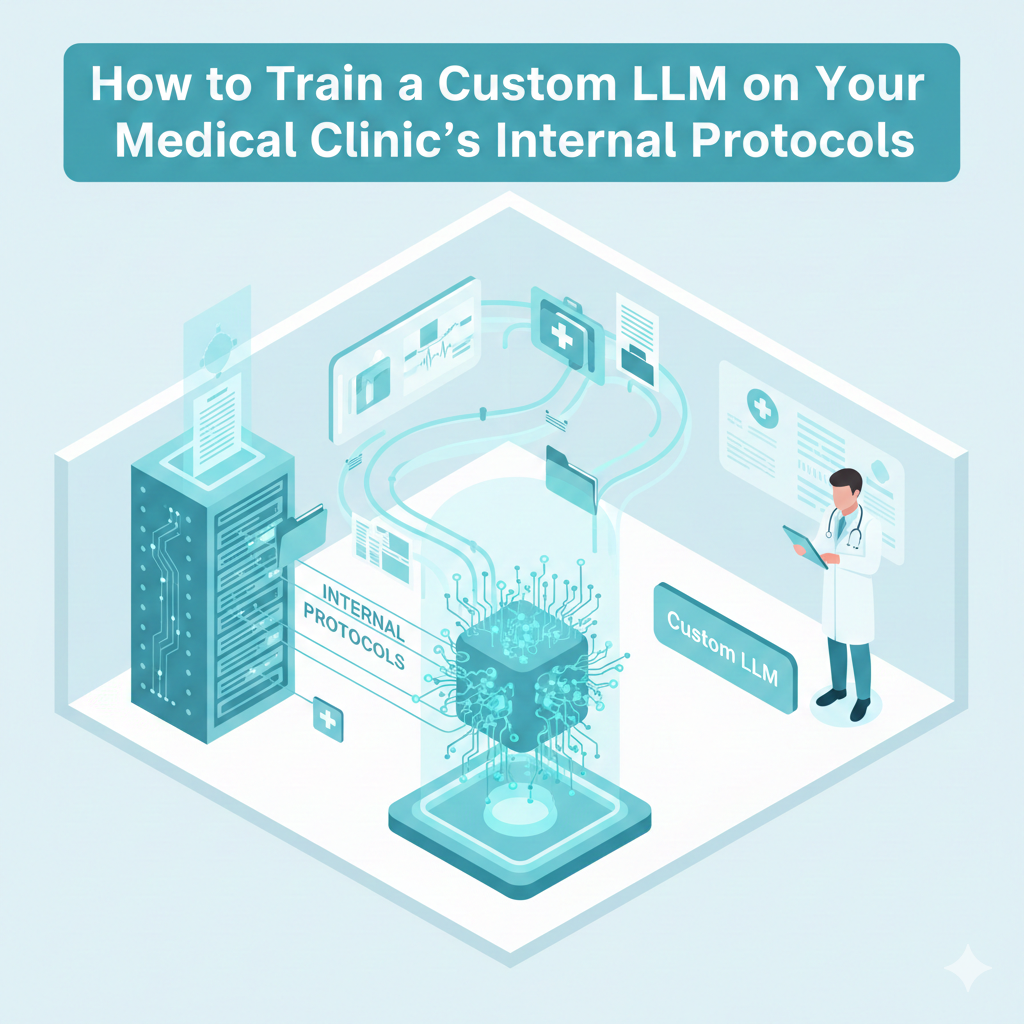
In the year 2026, medical clinics are actively investigating the possibility of using individualized large language models (LLMs) in order to boost patient care, simplify operations, and ensure that internal procedures are consistent with one another. A bespoke LLM may be taught especially on a clinic’s rules, treatment guidelines, documentation standards, and operational procedures. This enables the LLM to make suggestions that are aware of the context, create clinical notes, or aid staff members in making decisions in real time. When compared to generic AI models, which are trained on public data, a clinic-specific LLM is able to comprehend the subtleties of internal operations, local rules, and patient care standards. Through the application of artificial intelligence to the clinic’s internal procedures, the medical team is able to enhance efficiency, decrease mistakes, and guarantee compliance, all while preserving the best possible level of care.
A Mapping of the Internal Procedures
In order to begin the process of training a bespoke LLM, the first step is to create a detailed map of the clinic’s internal processes. Clinical processes, treatment paths, documentation formats, communication standards, and workflow norms are all included in this category. By precisely describing these components, the artificial intelligence model is guaranteed to have a structured framework that enables it to comprehend and provide correct outputs. For the year 2026, accurate mapping is very necessary in order to avoid discrepancies and the incorrect interpretation of critical regulations.
Methods of Data Collection and Preparation
The subsequent phase, which comes after the mapping of protocols, is to collect and organize the data that will be used in the training of the LLM. Policy papers, processes for patient management, treatment recommendations, standard operating procedures, and anonymised historical data are all examples of document types that fall under this category. In order to eliminate any patient-identifiable information while maintaining the context that is important for model learning, the data must be cleaned, organized, and anonymized. When data is properly prepared, artificial intelligence is able to learn successfully without compromising users’ privacy.
How to Determine the Appropriate LLM Architecture
It is possible to construct bespoke LLMs using either open-source models or proprietary structures that enable fine-tuning on data that is particular to another area. The technology capabilities of the clinic, the desired level of performance, and the concerns around privacy all play a role in the selection of the model. In order for internal protocols to be correctly included, models need to have the capability to provide fine-tuning or embedding injection procedures. When it comes to achieving a balance between performance, compliance, and scalability in the year 2026, adopting the suitable design is vital.
Internal Knowledge for the Purpose of Fine-Tuning
The process of fine-tuning comprises training the LLM on the prepared datasets of the clinic in order to embed the clinic’s internal procedures into the knowledge base of the model. Through the use of this approach, the artificial intelligence is able to provide outputs that are reflective of clinic-specific processes, medical language, and operational standards. Through the process of fine-tuning, the model is also able to increase its capacity to provide correct responses to queries, produce papers, or recommend further actions in patient care in accordance with internal regulations. Validation on a regular basis guarantees that the results are in line with methods used in the actual world.
Putting in place a secure data handling system
Because of the high level of sensitivity associated with medical data, all training, storage, and processing must adhere to stringent security measures. Protecting against illegal access or data leakage may be accomplished via the use of encryption, access limits, and isolated training environments. In order to comply with legislation regarding medical privacy, anonymization and stringent audit trails are an absolute need. When the year 2026 rolls around, the safe management of training data is just as important as the technological skills of the model.
Validation and Experimentation
After it has been fine-tuned, the individualized LLM need to be put through its paces against a number of different situations that are representative of the clinic’s actual operations. Through the process of validation, the model is guaranteed to precisely adhere to the internal regulations, comprehend the context, and refrain from producing suggestions that are hazardous or inconsistent. Obtaining feedback from clinical professionals during testing is very necessary in order to improve outputs and guarantee dependability prior to deployment.
Coordinating with the Workflows of the Clinic
The custom LLM may be included into the day-to-day operations of the clinic after it has been verified. There are a variety of potential uses, such as aiding with patient intake, creating treatment notes, ensuring compliance with internal procedures, or offering real-time coaching to staff members. The integration process need to be unobtrusive, safe, and harmonized with the software systems that are already in place, including EHR platforms. By the year 2026, efficient integration will increase usefulness while also retaining process efficiency.
Learning and Keeping Up to Date Constantly
The protocols, treatment standards, and operating processes of medical clinics are always being updated, as they undergo continuous evolution. It is necessary to do routine retraining or fine-tuning on a bespoke LLM in order to absorb these modifications. The artificial intelligence is kept up to date, dependable, and in line with the requirements of the clinic via continuous learning. It is also possible for feedback loops based on staff use to enhance performance over time.
Guaranteeing Compliance and Ethical Utilization
When deploying a bespoke LLM in a medical setting, it is necessary to comply with all applicable privacy rules, professional standards, and ethical principles. Whenever possible, models should steer clear of producing suggestions that might put the patient’s safety or privacy at risk. The appropriate and compliant use of artificial intelligence in therapeutic settings is ensured via monitoring, auditing, and regulated access.
The Importance of Maximizing Clinic Efficiency and Quality of Care
Custom LLMs that have received adequate training have the potential to greatly improve clinic operations, lessen the load of administrative work, and enable consistent, high-quality patient treatment. Clinics may accomplish speedier decision-making, enhance documentation accuracy, and empower staff to concentrate on patient engagement rather than monotonous procedural activities if they incorporate internal procedures into the knowledge base of the artificial intelligence (AI). In the year 2026, individualized learning modules (LLMs) are an essential element of contemporary digital transformation efforts in the medical field.