Designing “Human-in-the-Loop” Systems for Autonomous AI Approval
Designing “Human-in-the-Loop” Systems for Autonomous AI Approval
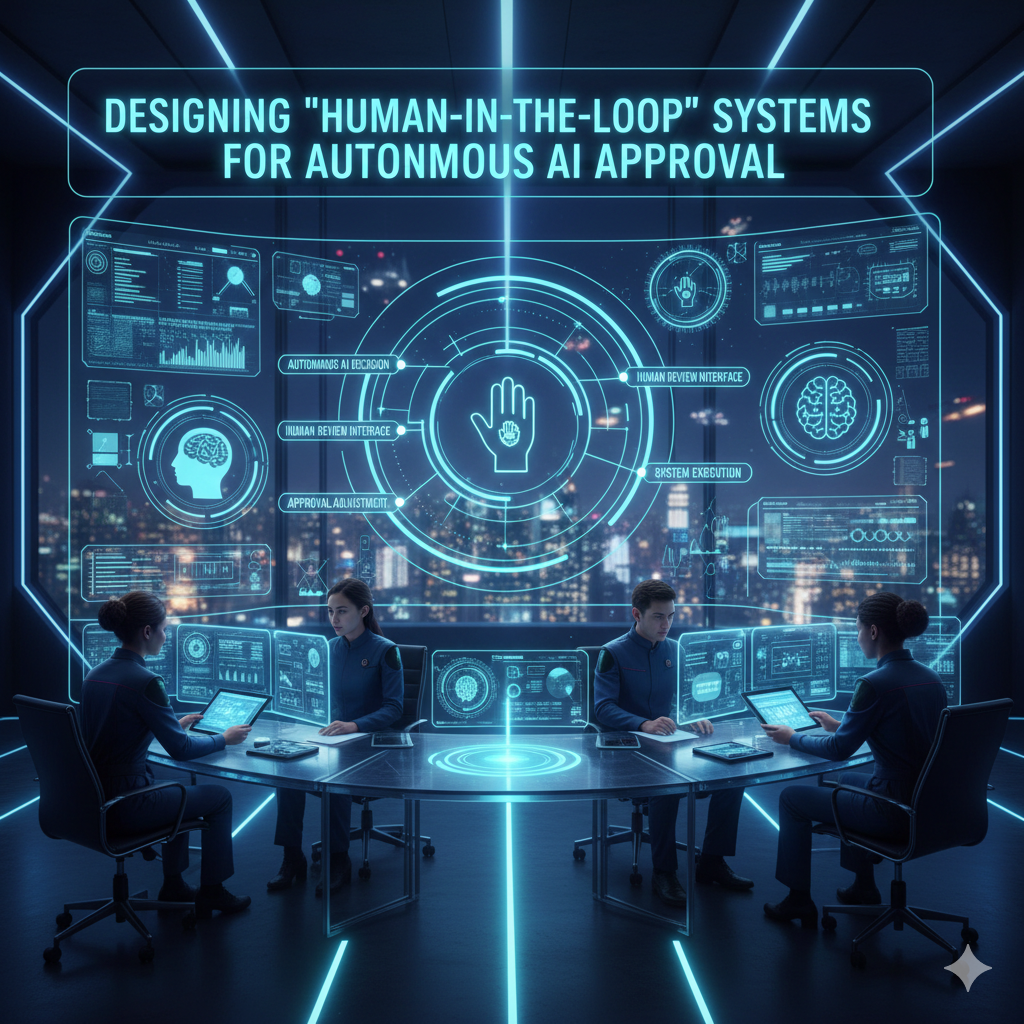
During the year 2026, enterprises are progressively incorporating “human-in-the-loop” (HITL) frameworks in order to guarantee accountability, safety, and ethical supervision. This is because autonomous AI agents are taking on decision-making responsibilities across a variety of corporate activities, including finance, human resources, and consumer interaction. In addition to being able to handle vast amounts of data, autonomous systems are also able to offer suggestions and even carry out activities without continual supervision. Certain judgments, particularly those that have a significant effect or regulatory ramifications, need human approval in order to reduce the likelihood of adverse outcomes. In order to strike a balance between efficiency and accountability, person-in-the-loop systems provide a regulated connection between the autonomy of artificial intelligence and human judgment. HITL is a cornerstone of responsible automation since it not only minimizes mistakes and biases but also offers transparency, compliance, and trust in AI-driven processes. This method is a critical component of responsible automation.
It is important to comprehend human-in-the-loop systems.
When it comes to artificial intelligence procedures, a human-in-the-loop system uses human judgment at crucial checkpoints. Artificial intelligence agents are responsible for analysis, prioritizing, and preliminary actions. Human reviewers are responsible for validating or approving crucial judgments. This guarantees that the results of high-stakes situations are in accordance with the rules, ethics, and legal obligations of the company. HITL systems are especially crucial when it comes to making choices that have an impact on health and safety, economics, people, or compliance. In the year 2026, HITL frameworks are seen as essential for the appropriate deployment of autonomous AI in commercial settings.
The Process of Establishing Approval Levels
Establishing which choices need to be approved by a human being is the first step in the process of designing an efficient HITL system. It is not necessary to exercise supervision over every activity; jobs that are low-risk, regular, or repetitive may be performed independently. Human intervention need to be automatically triggered for activities that are either high-risk or uncertain. At the same time as they provide efficiency, clear standards also preserve responsibility and accountability. In the year 2026, companies will set approval limits by using risk rating, impact assessment, and regulatory criteria.
Coupling Artificial Intelligence Agents with Human Workflows
Integrating human reviewers with AI agents in a seamless manner is one of the most important things. Information that is both clear and simple must be provided to people by the system. This information must include context, suggestions, and the logic behind choices made by AI. This enables people to make speedy decisions based on accurate information. Additionally, workflow integration guarantees that input from humans can be fed back into the AI, which improves the AI’s ability to make decisions in the future. In the year 2026, an efficient HITL design places more of an emphasis on seamless cooperation than on straightforward supervision.
Feedback Loops That Are Real-Time
Feedback is provided by human reviewers in HITL systems, which the artificial intelligence may utilize to change its behavior in the future. Acceptance, modification, or rejection of suggestions are all included in this term. Continuous learning from human input enhances the performance of the artificial intelligence, decreases the number of mistakes that occur repeatedly, and increases the correctness of decisions over time. Through the use of real-time feedback loops, adaptive systems are created that progress in accordance with the priorities of the company. In 2026, these loops will be a distinguishing characteristic of automation that is both intelligent and responsible.
The Struggle Between Accuracy and Speed
One of the difficulties associated with HITL systems is the upkeep of efficiency while also including human monitoring. Although fully autonomous AI can respond more quickly, it may also pose hazards. In addition to slowing down operations, excessive human review may also lessen the advantages that automation provides. Artificial intelligence (AI) should be used to perform regular activities, while humans should concentrate on choices that may have important repercussions. HITL frameworks need to optimize the balance. In the year 2026, hybrid processes are accurately tuned to achieve the highest possible levels of both speed and dependability.
In addition to Auditability, Monitoring
Because all human approvals, revisions, and rejections are documented alongside AI operations, HITL solutions have an inherent auditability that is not available with other systems. This results in the creation of a record that is open and accessible for compliance, quality control, and legitimate responsibility. The use of monitoring technologies allows for the tracking of approval trends, the detection of irregularities, and the guarantee of policy compliance. It is expected that by the year 2026, thorough audit trails would be the normal practice in regulated businesses and settings with high stakes for decision making.
Interface Design for Human Evaluation and Evaluation
When it comes to user interfaces for HITL systems, clarity, context, and the simplicity of decision-making should be among the top priorities. Humans need succinct summaries, danger indications, and pertinent facts without being inundated with an excessive amount of information. Users should be able to provide the artificial intelligence with feedback, discussion, and instructions in an expedient manner. The cognitive burden of human approvals is reduced and the accuracy of human approvals is improved by well-designed HITL interfaces. When it comes to the successful deployment of HITL in the year 2026, interface design is an essential component.
Oversight of Human Resources at a Large Scale
In order for HITL systems to effectively spread the burden of human reviewers, AI agents must grow to the point where they can handle thousands of judgments concurrently. For the purpose of ensuring that human attention is directed to the areas that need it the most, prioritization algorithms, automated routing, and dynamic assignment are used. Without overloading human reviewers, this enables firms to retain safety and accountability without compromising their standards. When it comes to large-scale autonomous operations in the year 2026, scalable HITL systems are absolutely necessary.
Making Certain That Artificial Intelligence Decisions Are Both Ethical and Responsible
Incorporating ethical issues into the decision-making process of autonomous AI is made easier by HITL frameworks. Humans serve as safeguards against prejudice, injustice, and unforeseen effects, ensuring that corporate ideals and social standards are aligned with one another. Ethical compliance may be improved with the incorporation of human input and monitoring of AI activity on a regular basis. When the year 2026 rolls around, human-in-the-loop systems are seen as an essential tactic for the deployment of artificial intelligence in sensitive and crucial sectors.
How Human-in-the-Loop Systems Will Develop in the Future
The person-in-the-loop system is a representation of the confluence of artificial intelligence efficiency and human judgment, which results in autonomous operations that are safe, responsible, and adaptable. Automation that is scalable may be achieved by enterprises with the deliberate integration of people at crucial checkpoints. This allows organizations to retain control and ethical supervision. HITL frameworks will play a pivotal role in the effective deployment of autonomous artificial intelligence across sectors in the year 2026. This will ensure that automation brings about an increase in productivity without sacrificing accountability.