Intelligent Supply Chain Risk Prediction With AI
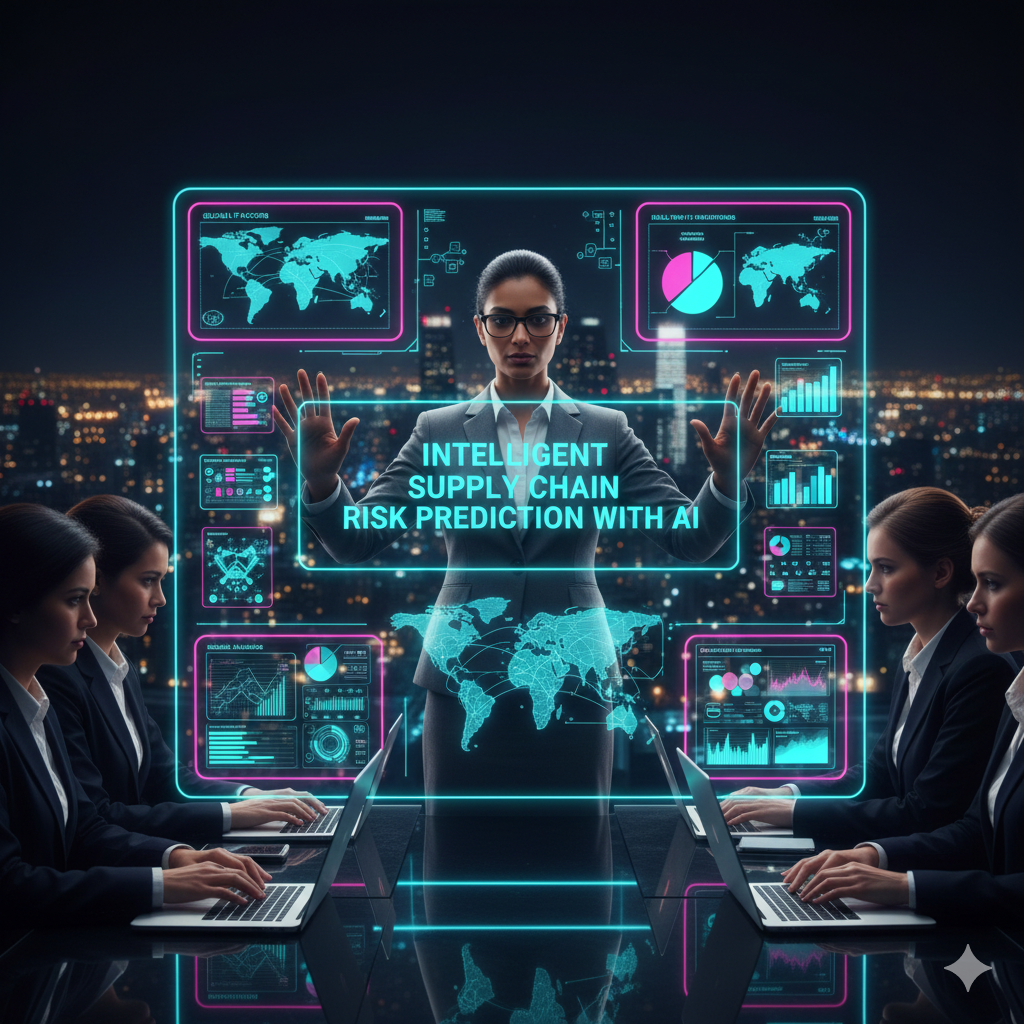
Intelligent Supply Chain Risk Prediction With AI
Industrial supply chains in the modern day are becoming not only more complicated but also more linked and susceptible to a broad variety of dangers. There is the potential for major financial losses, production delays, and reputational harm to occur as a consequence of disruptions brought about by natural catastrophes, delays imposed by suppliers, geopolitical events, or equipment breakdowns. When it comes to risk management, traditional techniques often rely on historical data and human analysis, which may not be able to catch new risks or intricate interdependencies. The use of artificial intelligence (AI) is revolutionizing supply chain risk management by making it possible to make intelligent, data-driven risk predictions. This gives businesses the ability to proactively minimize potential disruptions and preserve operational resilience.
Monitoring of Supply Chain Networks in Real Time at All Times
Risk prediction that is enabled by artificial intelligence starts with the constant monitoring of supply chain networks. In order to give a comprehensive perspective of operations, artificial intelligence systems gather data from many sources, including suppliers, logistics partners, manufacturing facilities, and market circumstances. The ability to identify early warning indications of potential disruptions, such as delayed shipments, shortages of raw materials, or shifting demand patterns, is made possible by real-time monitoring, which affords businesses the opportunity to take preventative measures before issues become more severe.
Analysis of Predictions for the Purpose of Risk Identification
The algorithms that are used for machine learning examine both historical and real-time data in order to identify trends that are related with supply chain risks. In addition to identifying abnormalities and predicting future disruptions, these algorithms are also able to calculate the probability of each risk and its potential consequence. The use of predictive analytics provides supply chain managers with the ability to foresee potential problems, such as the bankruptcy of suppliers, delays in transportation, or surges in demand. This allows them to take preventative actions and improve their contingency plans.
Simulation of Future Events and Evaluation of Their Effects
Artificial intelligence systems are able to simulate numerous risk scenarios in order to evaluate the possible effect on supply chain operations. Companies are able to analyze how each scenario impacts production schedules, delivery deadlines, and costs by modeling many factors, such as the dependability of their suppliers, the conditions of transportation, and the amounts of inventory. It is possible to get actionable insights via scenario simulation, which assists managers in prioritizing risks and properly allocating resources in order to avoid interruptions.
A Risk Assessment of the Supplier
The performance of suppliers in terms of delivery, financial stability, quality compliance, and geopolitical exposure are some of the factors that are taken into consideration by artificial intelligence. Artificial intelligence technologies indicate possible weaknesses within the supply chain and offer alternate sourcing methods throughout the process of continually analyzing the risk of the suppliers. Because of this, businesses are able to maintain a robust supply network, diversify their suppliers, and negotiate contracts in a smart manner.
Improving the Management of Inventory and Logistics Activities
Risk prediction that is powered by artificial intelligence helps to improve inventory and logistics management by predicting supply shortages or interruptions in transportation. Predictive models recommend making modifications to stock levels, the timing of reorders, and transportation routes in order to reduce the likelihood of possible dangers. Companies are able to decrease stockouts, eliminate excess inventory, and assure timely delivery even when faced with adverse circumstances if they integrate their inventory and logistics strategy with risk insights.
Integration with Digital Platforms and the Industrial Internet of Things
Integration with sensors connected to the Industrial Internet of Things (IIoT), enterprise resource planning (ERP) systems, and digital supply chain platforms all contribute to an improvement in the accuracy of intelligent supply chain risk prediction. A continuous risk assessment and preemptive mitigation are made possible by the incorporation of data from manufacturing equipment, warehouse sensors, and transportation monitoring systems into artificial intelligence models. Integrating systems not only increase visibility across the supply chain but also make it easier to make decisions in a coordinated manner.
Adaptive Learning in Response to Changing Dangers
Artificial intelligence systems are always learning from fresh data, which allows them to improve their forecasts and adapt to changing situations. Artificial intelligence algorithms make adjustments to risk models in accordance with the changing dynamics of supply chains, which may be caused by market trends, regulatory shifts, or developing global hazards. Even in extremely dynamic industrial situations, adaptive learning guarantees that risk forecasts continue to be accurate, relevant, and actionable throughout the course of time.
Reducing the Number of Costs and Disruptions in Operations
Artificial intelligence eliminates the potential for operational interruptions and decreases the financial losses that are connected with supply chain failures by detecting hazards before they occur. Delays in manufacturing, delayed deliveries, and unexpected expenditures associated with procurement may all be avoided by proactive mitigation. Another benefit of effective risk management is that it improves relationships with suppliers, boosts customer happiness, and contributes to increasing overall operational resilience.
Providing Assistance with Strategic Decision-Making
Through the provision of visibility into potential vulnerabilities, alternative sourcing choices, and operational objectives, risk insights supplied by artificial intelligence make it possible to effectively make strategic decisions. Decisions about procurement strategy, inventory allocation, and contingency planning may be made by supply chain managers when they are armed with accurate information. Decision-making that is informed by data ensures that risk management is proactive rather than reactive, which in turn supports long-term competitiveness and resilience.
The use of artificial intelligence to the prediction of risks in supply chains is revolutionizing the way in which industrial companies handle operational uncertainty. Artificial intelligence makes it possible to mitigate risks in a preemptive manner, decrease interruptions, and improve operational efficiency. This is accomplished via real-time monitoring, predictive analytics, scenario simulation, and adaptive learning. Companies are able to construct robust, data-driven networks that are capable of withstanding dynamic challenges while preserving productivity, cost efficiency, and long-term growth when they integrate artificial intelligence into supply chain management.