How AI Improves Logistics and Delivery Systems
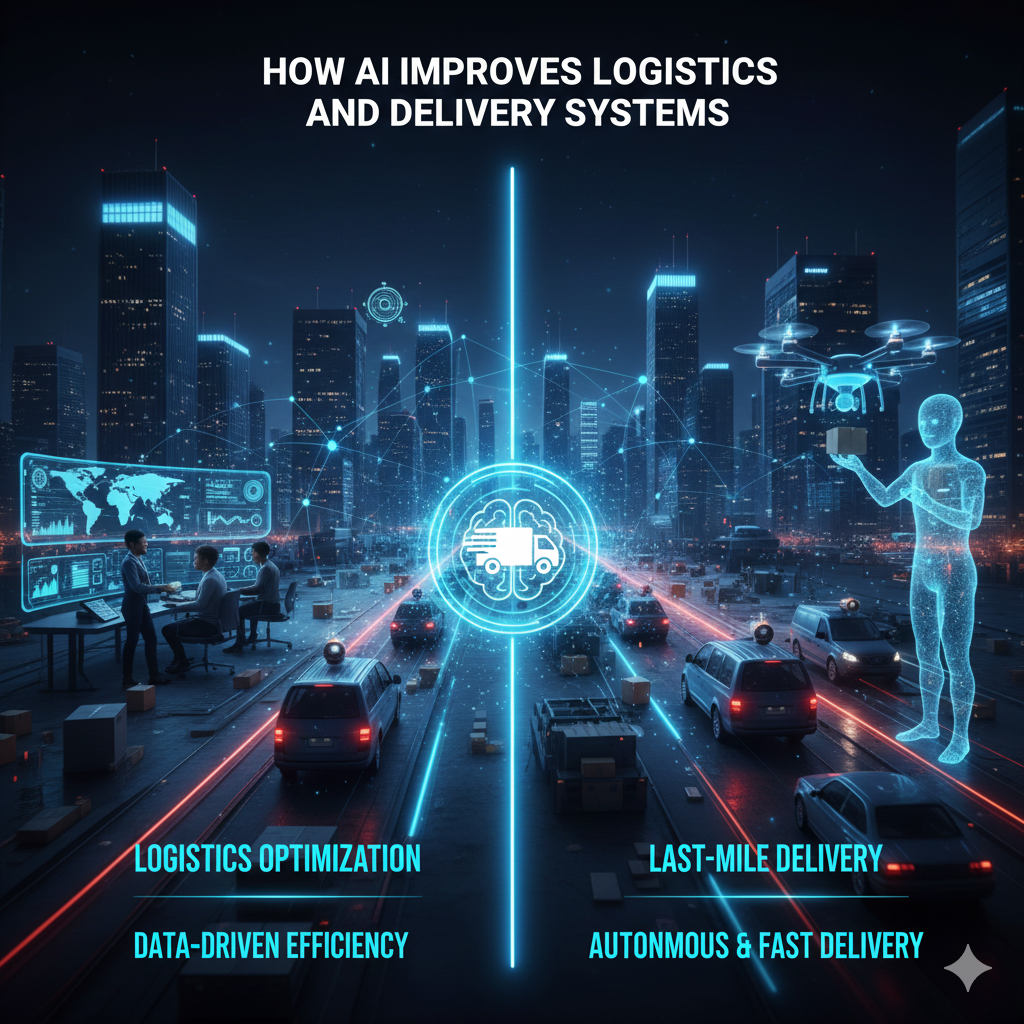
How AI Improves Logistics and Delivery Systems
The backbone of contemporary commerce is comprised of the logistics and delivery systems that enable the timely transportation of commodities across cities, nations, and continents. The management of logistics in the conventional sense is confronted with substantial obstacles as a result of the increasing demand for e-commerce, the rising expectations of customers, and the complexity of supply chains. The use of Artificial Intelligence (AI) is bringing about a revolution in the logistics and delivery industries by increasing efficiency, lowering prices, and strengthening the general dependability of these services.
Issues with Conventional Logistics
Conventional logistics is based on a combination of human planning, static routing, and the study of historical data. This often leads to inefficiencies that include deliveries that are behind schedule, routes that are not ideal, warehouses that are overstocked or understocked, and expensive transportation expenses. In addition, a number of unforeseen elements, like road congestion, weather-related interruptions, and demand that fluctuates unpredictably, contribute to the challenge of ensuring that deliveries are made on time.
Route optimization powered by artificial intelligence
AI utilizes machine learning algorithms to examine trends in traffic, locations for deliveries, capacities of vehicles, and the preferences of customers. Artificial intelligence (AI) is able to create optimum routes that reduce the amount of time spent traveling, the amount of fuel used, and the expenses associated with operations by analyzing this data in real time. The ability to immediately adjust to unanticipated barriers or delays in delivery is provided to logistics providers via dynamic rerouting, which helps to ensure that deliveries are completed more promptly and reliably.
Forecasting for Demand and Supply Management
Artificial intelligence enhances logistics via the prediction of demand at various places and periods. Artificial intelligence (AI) has the ability to predict which items will be needed in what locations and at what times by using previous sales data, seasonal patterns, and market indicators. This improves the allocation of goods between distribution centers and warehouses, which in turn decreases the number of stockouts, overstocking, and inefficiencies in transportation that occur.
Unmanned Aerial Vehicles (UAVs) and Autonomously Operated Vehicles (AOVs)
The last leg of the delivery process is undergoing a transformation as a result of the introduction of delivery drones and vehicles that are equipped with artificial intelligence technology that allows them to operate without a driver. These technologies are capable of navigating complicated routes, avoiding obstacles, and delivering things effectively with very little assistance from people. Autonomous systems make it possible to save expenses, accelerate the pace of delivery, and create solutions that can be scaled to meet times of high demand by lowering the need on human labor.
Monitoring and Tracking in Real Time
Real-time monitoring of shipments, vehicles, and storage conditions is made possible by artificial intelligence systems that are connected with Internet of Things devices and sensors. Real-time information on location, traffic conditions, and the possibility of delays is sent to logistics management. The capability of predictive analytics to foresee potential hazards like delayed arrivals, traffic jams, or equipment malfunctions enables the implementation of preemptive measures and enhances the general dependability of a system.
Decreasing the Costs Associated with Operations
Artificial intelligence is able to improve many different elements of logistical operations, such as the amount of fuel that is used and the distribution of employees among various tasks. Artificial intelligence (AI)-powered scheduling allows for the effective use of vehicles and delivery staff, while AI-powered analytics minimize waste during the transportation and management of inventory. Delivery speed and quality are not affected in any way by the reduction in operating expenses.
Improving the Way That Customers Interact with a Business
The consumer experience is enhanced by artificial intelligence, which provides precise delivery estimates, real-time tracking, and adaptive delivery alternatives. Predictive analytics is also capable of forecasting demand spikes and optimizing the availability of stock, so guaranteeing that items are delivered to clients in a timely and dependable manner.
Incorporation into Intelligent Supply Networks
The operation of AI-driven logistics does not occur in isolation. It has been incorporated into more extensive smart supply chain systems, which link together the processes of procurement, storage, manufacturing, and distribution. This comprehensive approach enables coordinated operations, the ability to make decisions more quickly, and the ability to respond more effectively to changes in the market or the environment.
The Development of the Artificial Intelligence Industry in the Logistics and Delivery Sectors
The logistics industry of the future will be more autonomous, intelligent, and predictive than it is now. Artificial intelligence will make it possible to implement completely integrated supply chains, adaptive delivery networks, and more intelligent last-mile solutions. Businesses who adopt AI-powered logistics will be able to take advantage of a number of benefits, including cheaper expenses, quicker delivery, more accuracy, and greater customer satisfaction, which will provide them a competitive advantage in a market that is continuously changing.
Artificial intelligence is bringing about a revolution in logistics and delivery systems by using predictive analytics, real-time monitoring, autonomous technology, and intelligent decision-making. Artificial intelligence (AI) allows businesses to satisfy the ever-increasing demands of modern-day trade while simultaneously maintaining high levels of operational excellence by increasing efficiency, lowering costs, and boosting dependability.