How to Use Agentic AI for 24/7 E-commerce Inventory Management
How to Use Agentic AI for 24/7 E-commerce Inventory Management
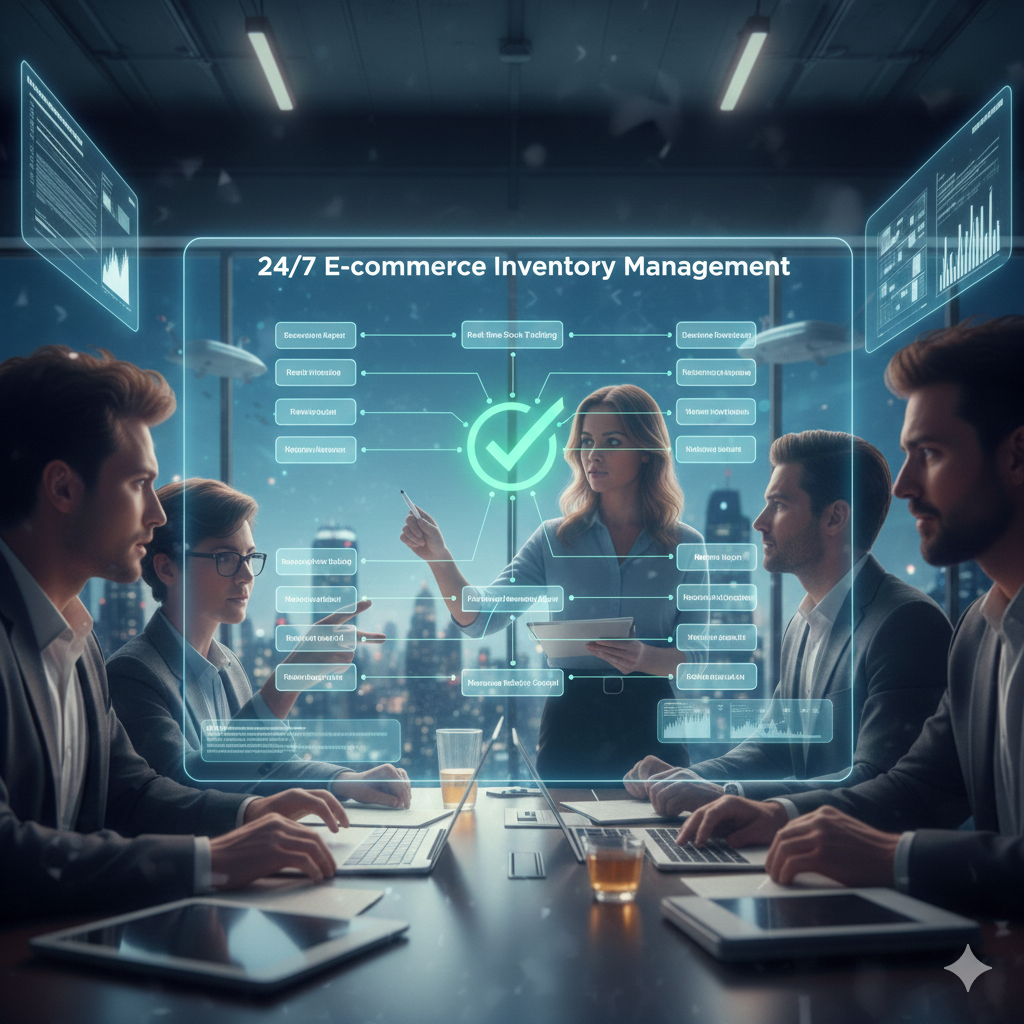
During the year 2026, the operations of e-commerce businesses are progressively being driven by agentic artificial intelligence systems that handle inventories on their own around the clock. Manual forecasting, frequent human inspections, and predetermined ordering rules are the three pillars around which traditional inventory management is built. This approach is replaced by agentic artificial intelligence, which includes continuous monitoring, predictive analytics, and decision-making in real time. Dynamic optimization of stock levels is achieved by the use of these systems, which assess sales velocity, seasonal trends, supplier performance, and consumer demand patterns. At the same time as this improves cash flow and customer happiness, it also minimizes the likelihood of stockouts and overstocking. Inventory knowledge that is available around the clock is increasingly becoming a competitive need in the new digital commerce industry, rather than an operational luxury.
Comprehending the Role of Artificial Intelligence in Inventory Systems
The term “agentic artificial intelligence” refers to autonomous agents that are able to perceive the state of the system, make choices, and carry out activities without continual input from humans. These agents are responsible for monitoring the flow of products, the state of the warehouse, order pipelines, and the lead times of suppliers in inventory management. Continuously, the AI determines whether or not the current supply levels correspond to the anticipated demand. Whenever the agent discovers inconsistencies, they have the ability to initiate restocking, make adjustments to price, or redistribute goods across different locations. Agentic artificial intelligence systems run as self-regulating supply chain managers in the year 2026.
Real-time forecasting of customer demand
Agentic artificial intelligence has the capacity to make demand forecasts in real time, which is one of its primary benefits. In place of depending just on historical averages, the system takes into account real-time sales data, traffic patterns, marketing activities, and other external signals such as seasonal behavior. The artificial intelligence is able to make dynamic adjustments to its projections as a result of this factor. Real-time forecasting minimises the amount of time that passes between changes in demand and reactions from inventory. Predictive demand modeling will serve as the basis for autonomous inventory optimization in the year 2026.
Decisions in Replenishment That Are Automated
Purchase orders may be generated automatically by agent-based artificial intelligence when stock levels are getting close to predetermined criteria. The sales velocity, the dependability of the source, and the storage limits all play a role in determining these thresholds, which are not static but rather adaptive. For the purpose of striking a balance between holding costs and service levels, the system chooses the appropriate reorder amounts and timing. This removes the need for manual intervention and mitigates the risk of human mistake. By the year 2026, replenishment will have transferred from being a periodic administrative effort to being a continuous algorithmic operation.
Coordination of Multiple Warehouse Sites
Intelligent management of inventory distribution is provided by agentic artificial intelligence for organizations that operate across many fulfillment locations. When it comes to effectively allocating goods, the system takes into consideration factors such as regional demand, shipment schedules, and storage capacity. Products might be moved from one area to another in order to avoid stockouts in certain regions and to cut down on delivery delays. The performance of logistics is improved as a result, and this does not need any manual coordination. By the year 2026, scalable e-commerce infrastructure will need warehouse orchestration that is driven by artificial intelligence.
Utilization of Suppliers to Improve Performance
The performance of suppliers is regularly evaluated by agentic AI, taking into consideration factors such as delivery speed, dependability, price stability, and defect rates. These statistics have an impact on judgments about reorders and the prioritizing of suppliers. It is possible for the system to automatically transfer demand to alternate vendors in the event that one of the suppliers becomes unreliable. The AI will, over the course of time, construct performance profiles that will direct strategic sourcing. Through the year 2026, the management of suppliers will evolve into a data-driven and autonomous optimization layer.
Emergency Stock Management That Is Dynamic
In the event that there is uncertainty over demand or interruptions in supply, safety stock serves as a cushion. For the purpose of calculating safety stock levels, agentic AI use probabilistic models rather than predetermined rules in a dynamic manner. When there is a high level of volatility, the system will raise the buffer levels, whereas when circumstances are steady, it will decrease the amount of extra inventory. In addition to reducing the amount of capital that is locked up, this adaptive method enhances resilience. In the year 2026, safety stock is no longer at a fixed level but rather is continuously optimized by intelligent systems.
The Detection of Anomalies and the Prevention of Risk
Anomalies, such as abrupt spikes in sales, inventory mismatches, or delays in supplier deliveries, are monitored by agentic artificial intelligence systems. These signals could be an indication of fraud, faults in the system, or new trends in the market. The artificial intelligence has the ability to independently start remedial steps, freeze activities, and generate alarms. Cascading failures across the supply chain may be avoided with early detection procedures. When autonomous commerce systems are implemented in the year 2026, anomaly detection will be an essential component of risk management.
The incorporation of pricing and promotional strategies
Both pricing strategies and inventory information are intimately related to one another. A dynamic adjustment of price may be made by agentic AI in order to clear out surplus stock or to reduce demand for things that are restricted in inventory. Additionally, it ensures effective coordination with marketing activities in order to guarantee sufficient stock availability prior to promotions. The synchronization of inventory and price allows for the maximization of income while simultaneously decreasing waste. Pricing and inventory management are integrated into a single intelligent system in the year 2026.
Multiple layers of human oversight and control
Though they have a great degree of autonomy, artificial intelligence systems still need human control. Managers are responsible for establishing ethical rules, budgetary limits, and strategic boundaries. Within these constraints, the artificial intelligence runs while taking care of day-to-day execution. In order to guarantee accountability, transparency, and alignment with corporate objectives, human monitoring is essential. When the year 2026 rolls around, the most efficient systems are those that blend autonomous execution with strategic human control.
Using Agentic Artificial Intelligence to Scale Retail Operations
Businesses that engage in e-commerce are able to expand without having to raise their operational workforce proportionally because to agentic AI. The management of thousands of goods across numerous warehouses and marketplaces may be accomplished by a single system at the same time. Inventory management is transformed from a labor-intensive activity into a digital process that may optimize itself automatically as a result of this. Inventory intelligence that is powered by artificial intelligence becomes a crucial differentiation as competition grows more intense. When the year 2026 arrives, agentic artificial intelligence will serve as the basis for e-commerce ecosystems that are scalable, robust, and high-performing.