AI Applications in Agricultural Yield Prediction
AI Applications in Agricultural Yield Prediction
The agricultural sector is making more use of technology to increase production, cut down on waste, and guarantee the availability of food. Artificial Intelligence (AI) is regarded as one of the most revolutionary technologies within this industry. By doing in-depth analyses of complex datasets, monitoring environmental conditions, and predicting crop performance with a high degree of accuracy, artificial intelligence applications in the field of agricultural yield prediction are assisting farmers, agronomists, and policymakers in making well-informed choices.
The Difficulties Associated with Conventional Yield Prediction
Historical data, farmers’ experience, and observations of the seasons are the most common traditional techniques of estimating crop production. Even if these methodologies provide some insights, the extent to which they are accurate is constrained by the fluctuation of weather patterns, the state of the soil, infestations of pests, and other environmental variables. Predictions that are not correct might result in an inefficient allocation of resources, a decrease in profitability, and discrepancies in the food supply.
The Ways in Which Artificial Intelligence Improves Yield Prediction
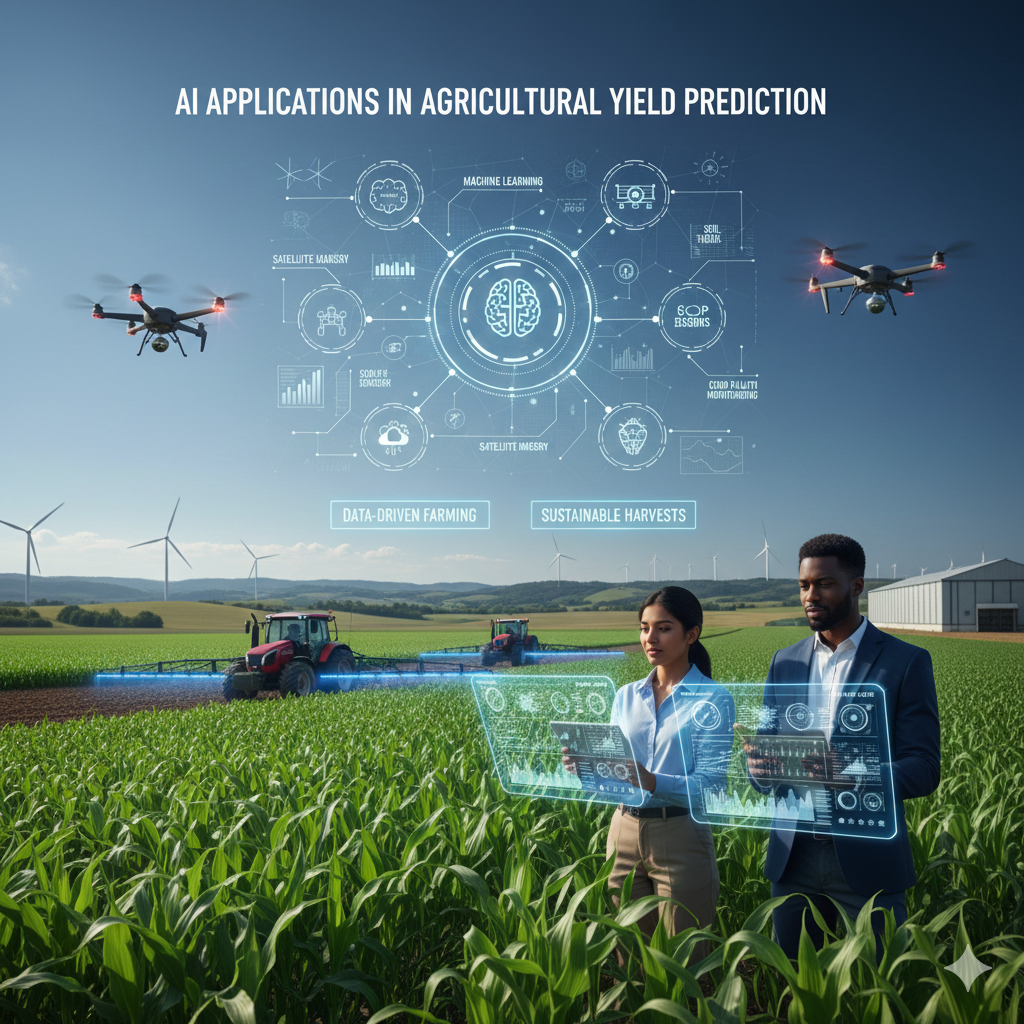
Artificial intelligence makes use of machine learning techniques, computer vision, and big data analytics in order to investigate a variety of factors that have an impact on the development of crops. Artificial intelligence systems are able to provide more accurate yield predictions than conventional approaches by incorporating historical crop data, weather patterns, soil health, satellite images, and real-time sensor data into their calculations. Farmers are able to optimize the timing of planting schedules, irrigation, fertilization, and harvests with the assistance of these projections.
Analysis of Data and Monitoring in Real Time
Internet of Things (IoT) sensors and drones are crucial in the collection of data in real time from many domains. Artificial intelligence (AI) systems are used to analyze this data in order to identify whether or not plants are experiencing stress, nutritional deficits, insect activity, or irrigation problems. Farmers are able to take preventive steps to avert any losses and enhance the general health of their crops as a result of constant monitoring.
Insights That Are Provided in Advance for the Management of Resources
Yield prediction powered by artificial intelligence (AI) delivers insights that may be acted upon to improve the management of resources. By calculating the ideal amount of seeds, fertilizers, and water needed for every plot, farmers are able to cut down on wastage and decrease the overall expenses of production. Agricultural enterprises are able to plan strategies for market supply, storage, and transportation more successfully when they are able to precisely estimate yields.
Mitigation of Risks and Adaptation to the Climate
In the agricultural industry, one of the most significant hazards is the unpredictability of the weather and climate. Artificial intelligence models are capable of incorporating information such as temperature changes, climate projections, and rainfall patterns in order to make predictions about the effects that these factors will have on the yields of crops. Farmers are able to use adaptive methods as a result of this, which might include adopting robust crop types or changing the dates on which they plant, so reducing the impact of unfavorable circumstances.
Planning for the Market and Improving the Supply Chain
The use of artificial intelligence (AI) to make forecasts about crop yields has advantages not just for farmers but also for the larger agricultural supply chain as a whole. Forecasts that are precise enable distributors, processors, and retailers to successfully plan out their sales tactics, inventory, and transportation. This has the effect of reducing the amount of food that is wasted, guaranteeing a regular supply, and maintaining stable pricing in the market.
Integration with the precision agriculture system
Artificial intelligence (AI) is the driving force behind a key element of precision agriculture, which is the ability to estimate yields. Farmers are able to carry out very precise interventions by using artificial intelligence (AI) insights in conjunction with gear that is equipped with Global Positioning System (GPS) technology, variable-rate irrigation, and automated fertilization. The use of this method results in the maximization of production, the conservation of resources, and the encouragement of sustainable agricultural practices.
Agriculture and the Advancement of Artificial Intelligence in the Coming Years
The agricultural yield prediction industry is on the cusp of seeing even more significant benefits from the use of artificial intelligence in the future. It is anticipated that the use of sophisticated deep learning algorithms in conjunction with greater access to sensor data and high-resolution satellite images would improve the precision of predictions on both a macro and a micro scale. Agriculture will become more lucrative, efficient, and resilient to climate change as a result of the increased automation of agricultural operations via the use of autonomous farming equipment and artificial intelligence-driven decision support systems.
Agricultural yield prediction is being revolutionized by the use of artificial intelligence technologies, which are altering the decision-making process in farming. Through the integration of real-time monitoring, predictive analytics, and precision interventions, artificial intelligence allows farmers to maximize the productivity of their crops, efficiently manage resources, and guarantee that their agricultural operations are both lucrative and sustainable.