How AI Enhances Cybersecurity: Threat Detection in Real Time
How AI Enhances Cybersecurity: Threat Detection in Real Time
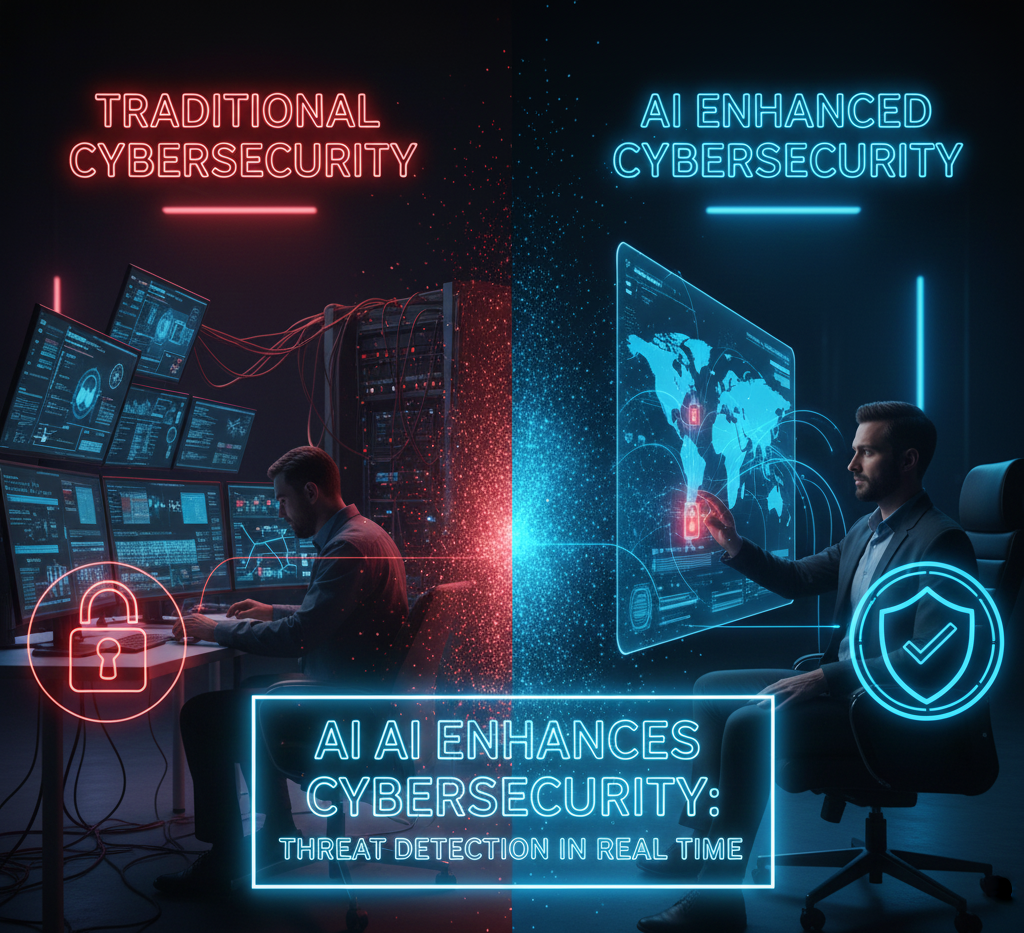
Cyber dangers are evolving at a quicker pace, are more complicated, and are more automated than they have ever been. Conventional security systems, which depend on human monitoring and static rules, have difficulty keeping up with attack patterns that are in a state of perpetual evolution. As a result of this change, companies of all sizes have begun to rely more heavily on artificial intelligence-powered cybersecurity solutions that are able to identify attacks as they occur, adjust instantaneously to any new dangers that may arise, and decrease the amount of work that must be done by human security teams. Artificial intelligence has become an essential line of defense, with the ability to examine large volumes of data, recognize abnormalities, and react to assaults before they may result in harm.
What Are the Limitations of Conventional Cybersecurity?
The majority of conventional cybersecurity technologies depend on recognized signatures and predetermined regulations. They are only able to identify viruses, malware, and questionable behavior if it corresponds to a pattern that is already in their database. This constraint leaves systems susceptible to threats that are undiscovered, mutated, or brand new. In order to get around systems that are no longer current, hackers have turned to the use of automated scripts, phishing emails that are created by artificial intelligence, and sophisticated stealth tactics. In the absence of adaptive intelligence, businesses are confronted with heightened risk and delayed reactions.
The ways in which artificial intelligence is able to analyze large amounts of security data
Every piece of equipment, application, and network produces an ongoing flow of data, including logs, access requests, file transfers, user activity, and system events. This information cannot be processed in real time by human analysts by manual means. In contrast, artificial intelligence systems have the ability to scan and evaluate millions of data points in a matter of seconds. In order to detect potential security risks, machine learning models examine regular patterns of activity and compare them to incoming data in order to pinpoint small differences that might be of concern. As a result of this speed and precision, companies are able to detect and respond to assaults at the same time that they start.
Immediate Threat Identification and Warnings Before the Fact
The identification of abnormalities in the first phases of an assault is the mechanism by which threat detection that is driven by artificial intelligence functions. It alerts the user if there is any login activity that is out of the ordinary, any unexpected data transfers, any access from areas that are not the norm, or any suspicious patterns that do not correspond to the user’s regular behavior. By providing security professionals with early warnings that enable them to prevent threats from escalating, this real-time alert system helps to ensure their safety. Organizations are able to achieve a number of different objectives as a consequence, including minimizing the effects of data breaches, reducing the amount of time that is spent on inactivity, and ensuring that private information is safeguarded in a more efficient manner.
Comprehension of Anomaly Detection
Detection of anomalies is one of the greatest characteristics of artificial intelligence (AI) when it comes to cybersecurity. Artificial intelligence does not depend on a predetermined list of potential risks; rather, it is trained to recognize what “normal” behavior seems to be for a certain network or user. It will quickly raise a warning as soon as it comes across anything that falls outside of this pattern, such as an illegal attempt to access restricted files or a rapid rise in outgoing traffic. It is possible to identify developing malware, insider threats, and account takeovers that conventional technologies could overlook with the use of this method.
Intelligence on Potential Threats
Artificial intelligence is capable of doing more than simply identifying hazards that are present in the moment; it can also foresee threats that may emerge in the future. Tactics, strategies, and procedures used by cybercriminals are determined by the analysis of global cybersecurity data by machine learning models. Artificial intelligence systems have the ability to predict the patterns of cyberattacks and provide advance warning to enterprises before any weaknesses are taken advantage of by gaining a knowledge of how threats develop. Organizations are able to strengthen areas that are deficient and make preparations for their defenses in advance with the assistance of this predictive intelligence.
Automatic Response to Incidents
The capabilities of contemporary artificial intelligence (AI) cybersecurity systems extend beyond the identification of threats. By taking actions like as banning suspect IP addresses, isolating devices that have been infected, or terminating user sessions that pose a hazard, they are able to react automatically to certain kinds of attacks. A substantial reduction in the amount of time that is required to identify a danger and then contain it may be achieved via the use of an automated response. Faster responses result in fewer systems being damaged, fewer data being compromised, and lesser expenses for recovery.
Email and Phishing Protection Utilizing Artificial Intelligence
Phishing is still one of the most prevalent and hazardous forms of attack strategies. Through the analysis of sending history, writing habits, link activity, and message structure, artificial intelligence (AI) is able to enhance the security of email. Even when there are no overt indicators of bad intentions present, it is capable of detecting phony emails that imitate authentic conversation. Artificial intelligence is also able to identify complex phishing attempts that have been created by other AI technologies in addition to recognizing minor linguistic cues.
Securing Internet of Things Devices and Networks
As a result of the increased use of smart devices and linked systems, the attack surface for hackers has become more extensive. A significant number of these gadgets do not have robust security measures included into their design. The conduct of these individuals and their interactions on the network are constantly being observed by artificial intelligence, which automatically marks any activity that seems to be out of the ordinary. This offers protection to a wide range of devices, including office gadgets like as routers and printers, as well as Internet of Things (IoT) systems found in hospitals, factories, and smart homes.
Accelerating the Detection of Malware and Ransomware
Ransomware attacks have gotten more and more damaging, encrypting information and demanding payment in a matter of minutes. Unexpected alterations to files, unique encryption procedures, and abrupt updates to user permissions are all early warning signs of ransomware that are recognized by artificial intelligence technologies. The moment these signals are identified, it becomes possible for systems to prevent damaging actions from taking place prior to the attack’s propagation.
Improving the Security of Endpoints
Laptops, cellphones, and workstations are examples of endpoints that are often targeted by hackers for infiltration. Unauthorized programs are blocked, suspicious downloads are prevented, and the execution of malware is stopped by AI-based endpoint security systems, which continually monitor the activity of devices. Even in the event that devices are not connected to the corporate network, this guarantees that they are protected at the forefront.
Artificial Intelligence That Is Collaborative and Human Expertise
Although artificial intelligence is improving cybersecurity, it is not a substitute for the ability to make decisions based on human experience. When events occur, security experts are responsible for interpreting alarms, investigating complicated risks, and making key judgments. Artificial intelligence functions as a force multiplier by taking over monotonous duties, scanning large volumes of data, and allowing people to concentrate on strategy, analysis, and the planning of long-term defense.
Artificial Intelligence and Its Role in the Evolution of Cyber Defense
As attacks become more automated and unpredictable, artificial intelligence will play an increasingly important role in cybersecurity. In the future, systems will use more in-depth contextual analysis, enhanced predictive modeling, and proactive defensive tactics that will effectively neutralize threats before they can affect crucial systems. More robust safeguards, quicker detection capabilities, and more robust infrastructures will be acquired by corporations that include artificial intelligence into their security stack.